Index
Receive our newsletter
During the 2024-2025 academic year, the Spanish university system recorded 1,827,272 enrolled students, representing a 3.5 percent increase compared with the previous year. Within this landscape, Madrid and Catalonia account for more than 35 percent of the total student population, which helps explain the strong housing pressure surrounding university campuses in both regions, according to Fundación CYD.
This level of academic mobility has positioned Madrid and Barcelona among the most dynamic student housing markets in Europe. Demand, however, is not distributed evenly. Some neighborhoods are heavily shaped by their university presence and dominate the rental market, while other districts are beginning to absorb part of the growth due to improved connectivity and more accessible price levels.
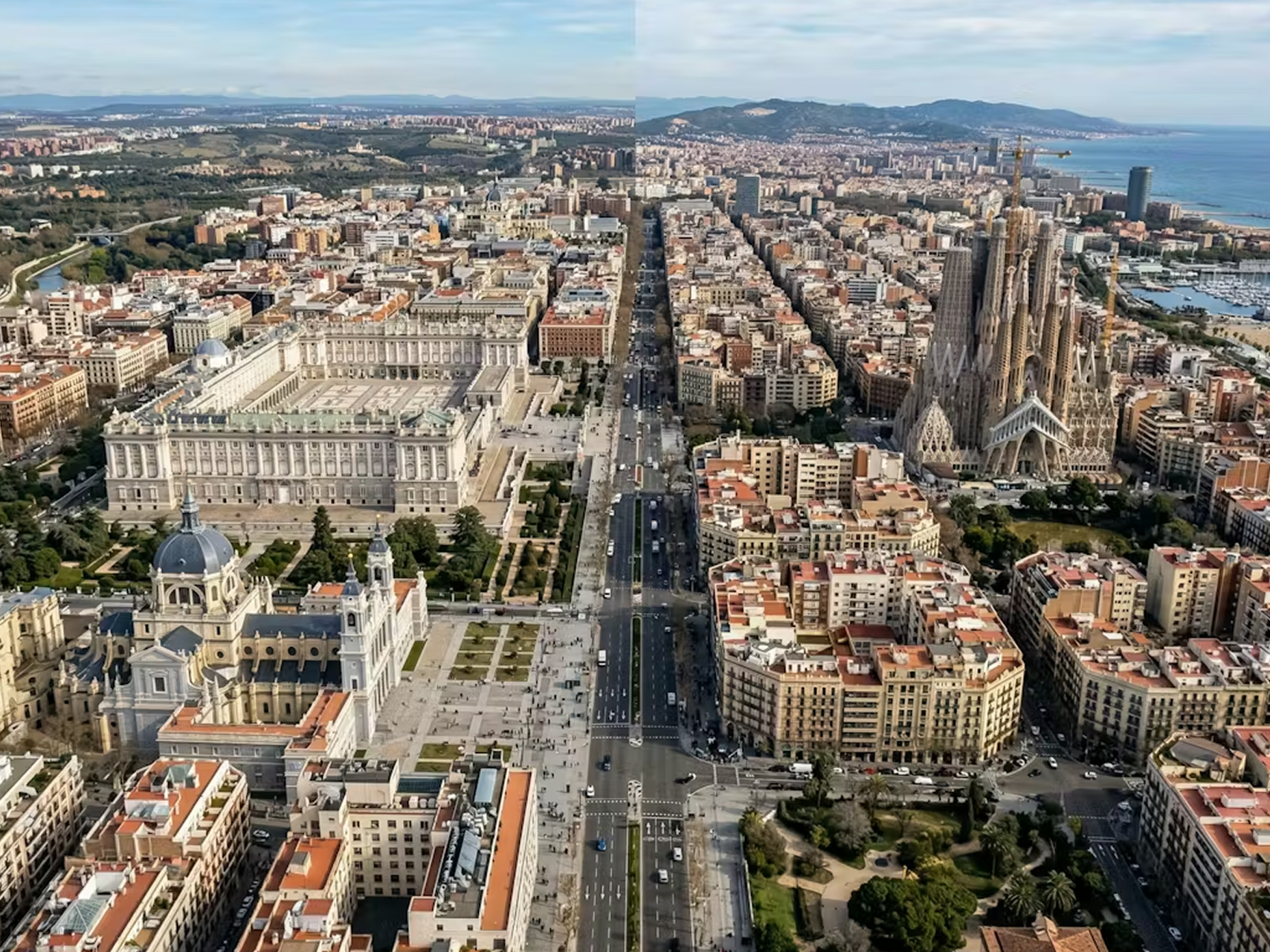
The Student Housing Market Report: Areas and Pricing in Madrid and Barcelona 2026 examines this geographic structure in detail. The study reviews the spatial distribution of students, neighborhood price ranges, the availability of PBSA beds (Purpose Built Student Accommodation), and the actual level of demand coverage between 2024 and 2026.
Madrid: Defined academic clusters
The Spanish capital contains several residential hubs directly linked to major university campuses. The Ciudad Universitaria and Moncloa area remains the main concentration point for students. Immediate proximity to the Complutense University of Madrid and the Polytechnic University, combined with its role as a major transportation hub, explains the high density of academic housing in this district.
According to UniScopio, the area contains 23 residence halls and student residences, representing around 40 percent of the city’s dedicated student housing supply. Rental prices reflect this central position. Rooms typically range between €550 and €750 per month, while residence beds often fall between €1,100 and €1,600.
Further east, Chamberí and Argüelles maintain a well-established academic profile. Direct access through the Princesa corridor provides convenient connections to multiple faculties, academic libraries, and educational centers. In recent years, the area has also seen an increase in premium residences and coliving developments, encouraged by proximity to universities and administrative institutions.
Within the Centro district, Malasaña continues to attract international students. Nearby business schools, arts academies, and international programs support a constant rotation of young residents. Municipal census data identifies ratios close to one student for every four residents, one of the highest concentrations in Madrid.
Meanwhile, Vicálvaro has started to gain relevance as an alternative outside the city center. The presence of the Rey Juan Carlos University campus and lower housing costs compared with central districts have increased interest in the area. According to Idealista data trends, searches for youth rentals in Vicálvaro increased by more than 18 percent year over year, with room prices ranging between €450 and €625.
Barcelona: Urban campuses and emerging creative districts
In Barcelona, student distribution follows a somewhat different pattern. The city combines large academic campuses with districts where education, innovation, and cultural activity coexist.
Les Corts and Pedralbes host Zona Universitària, home to both the University of Barcelona and the Polytechnic University of Catalonia. This area includes more than fifteen student residences and traditional residence halls, along with a large share of the city’s premium accommodation supply, according to UniScopio. Room prices generally range between €550 and €750, while residence beds frequently exceed €1,500 per month.
Eixample Esquerra stands out because of its central location. Historic faculties of the University of Barcelona, proximity to Hospital Clínic, and an extensive public transport network make the district attractive for both domestic and international students. Digital platforms for shared housing also identify this area as one of the largest concentrations of shared apartments in the city.
A different dynamic appears in Poblenou, a district closely connected to the development of the 22@ technology hub. The presence of the Pompeu Fabra University Communication Campus and several design schools has supported the opening of new generation residences. During the past two years, three accommodation centers aimed at international and creative profiles have opened, according to data from 22@Network.
The neighborhood of Gràcia maintains a strong local identity, characterized by pedestrian streets and an active cultural scene. This environment attracts many students enrolled in international programs. Data from the Barcelona City Council shows that four out of ten new young residents come from abroad, reinforcing the district’s international profile.
Finally, Ciutat Vella, particularly the Raval area, remains an important reference point for students due to its proximity to faculties of both the University of Barcelona and Pompeu Fabra University. A concentration of cultural and academic institutions within a compact radius encourages student mobility, although the older housing stock places some limitations on available supply.
A market under structural pressure
Despite the development of new residences, the capacity of purpose built student housing remains limited. Spain currently offers between 85,000 and 120,000 beds in student residences and PBSA solutions, compared with more than 600,000 mobile students nationwide. This places national coverage between 10 percent and 20 percent, according to sector estimates referenced by EjePrime.
The result becomes visible in certain districts of Madrid and Barcelona where sector analysis identifies ratios close to four students per available bed. This pressure on supply explains the emergence of new residential formats and the expansion of coliving in central neighborhoods.
At the same time, coordination between property owners, housing operators, and universities is gaining importance. Efficient inventory management plays a decisive role in urban markets with high student mobility.
New technological solutions have emerged to connect both sides of the market. Arrento, the mid term rental management software developed by Lodgerin, enables owners and property managers to keep their housing inventory updated and visible. Meanwhile, Abroad by Lodgerin, used by universities and organizations to manage international programs, channels accommodation requests from students arriving in Spain each semester.
The connection between these software solutions allows available housing to align more efficiently with institutional demand. In cities such as Madrid and Barcelona, where pressure on student accommodation continues to rise, this type of coordination is likely to shape how the market evolves in the coming years.

Jorge Padilla
Jorge Padilla, with a degree in Business Administration from Tecnológico de Monterrey and a Master’s in Marketing from Trinity College Dublin, has three years of experience in eCommerce and marketing across sectors such as Food Service, Tourism, and Education. He has worked in international environments in LATAM, Dublin, and Madrid, and holds a Google Digital Marketing certification. He is currently a Marketing Assistant at Lodgerin, managing digital campaigns, SEO optimization, and strategies for brand growth and conversion.